
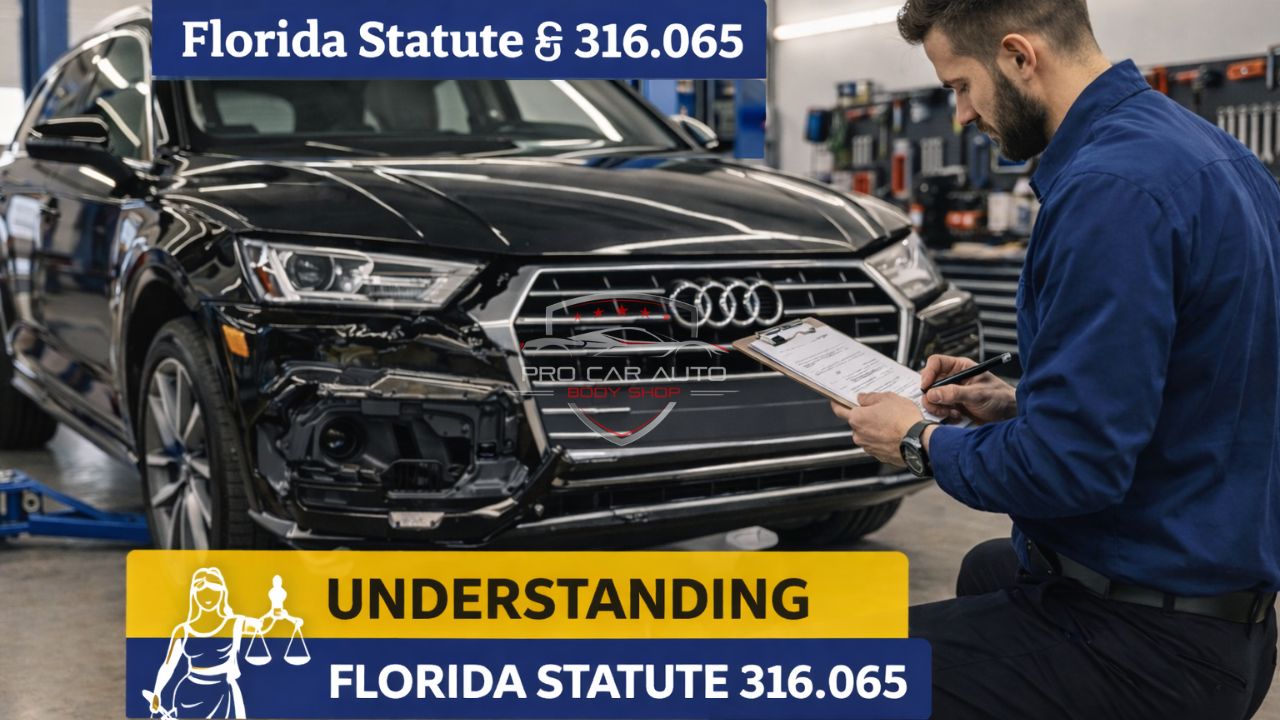
Is the Police Report Mandatory? Understanding Florida Statute § 316.065
From the insurance claim specialists at Procar Auto Bodyshop who help customers navigate accident reporting every single day
It’s 3 PM on a Tuesday, and someone just backed into your car in a parking lot. Minor damage. The other driver is apologetic and wants to “just handle it privately.” They’re asking, “Do we really need to call the police?”
Or maybe you just had a fender bender on I-95. Traffic is backed up, everyone seems okay, and you’re wondering if it’s worth waiting an hour for law enforcement to show up.
I get these questions at Procar Auto Bodyshop literally every single week. And here’s the thing: understanding Florida Statute § 316.065 could save you thousands of dollars and a world of legal trouble. Let me break down the law in plain English and tell you exactly when a police report is mandatory—and when you should get one anyway, even if it’s not.F
What Florida Statute § 316.065 Actually Says?
Let’s start with what the law requires. I’m going to translate the legal language into something you can actually understand.
The Core Requirement
Under Florida Statute § 316.065, you must immediately notify law enforcement if a crash results in:
- Injury to any person (no matter how minor)
- Death of any person
- Damage to a vehicle to the extent that it cannot be driven safely (meaning the vehicle must be towed from the scene)
That’s it. Those are the three situations where calling the police isn’t optional—it’s the law.
What “Injury” Actually Means?
Here’s where people get confused. Florida law doesn’t define a minimum threshold for “injury.” That means:
- Someone complains their neck hurts? That’s an injury—call police.
- A passenger has a headache after impact? That’s an injury—call police.
- You feel totally fine now but worried about whiplash later? Get it documented—call police.
Pro Tip from the Shop: People often don’t feel pain immediately after an accident due to adrenaline. We’ve seen customers walk into our shop saying “I felt fine at the scene,” only to be in severe pain 24 hours later. By then, it’s too late to get a police report, and that makes the insurance claim significantly harder.
What “Cannot Be Driven Safely” Means?
This is subjective, but Florida law enforcement typically considers a vehicle unable to be driven safely if:
- Wheels are damaged and the vehicle can’t roll properly
- Steering is compromised
- Lights or signals are broken (especially at night)
- Fluid leaks create a hazard
- Airbags deployed (vision obstruction, safety concern)
- Structural damage affects vehicle stability
- Any condition that violates Florida’s vehicle equipment laws
Important: Even if you technically can drive the car, if it’s unsafe to do so, you’re required to call police. And attempting to drive an unsafe vehicle can result in additional citations.

The Criminal Penalties for Not Reporting
Now let’s talk about what happens if you don’t report when you’re supposed to.
It’s a Misdemeanor
Failing to report a crash that meets the criteria under § 316.065 is a second-degree misdemeanor in Florida, punishable by:
- Up to 60 days in jail
- Up to $500 in fines
- Possible suspension of driving privileges
- Points on your driving record
I’ve seen people face these penalties, and trust me—it’s not worth the risk. The “convenience” of avoiding a police report can cost you way more than the hour you’d spend waiting for an officer.
Leaving the Scene vs. Not Reporting
These are different violations:
- Leaving the Scene (Hit and Run): Much more serious, can be a felony if there’s injury
- Failure to Report: Misdemeanor for not notifying authorities when required
Both are illegal, but leaving without exchanging information is far worse. Don’t confuse the two.
When the Law Doesn’t Require a Report (But You Should Get One Anyway)?
Here’s where my 15+ years of experience helping customers with insurance claims comes in. Just because the law doesn’t require a police report doesn’t mean you shouldn’t get one.
The “Minor” Parking Lot Fender Bender
Scenario: Someone dings your door in a parking lot. No injuries. Both cars are drivable. Damage looks minor—maybe a few hundred dollars.
What the Law Says: No police report required.
What I Say: Get the report anyway. Here’s why:
Reason #1: People’s Stories Change
The friendly driver who apologizes profusely at the scene might suddenly “remember” things differently when they talk to their insurance company. We’ve seen it hundreds of times:
- “Actually, I think they hit ME.”
- “I don’t remember admitting fault.”
- “There was pre-existing damage.”
A police report locks in the facts while everyone’s memory is fresh.
Reason #2: Hidden Damage
That “minor” door ding? Our technicians often find $2,000–$3,000 in damage once we get the panel off. Modern cars have sensors, wiring, and structural components you can’t see from outside. Without a police report, proving the other driver caused $3,000 in damage becomes a nightmare.
Reason #3: Injury Claims After the Fact
Florida is notorious for staged accidents and fraudulent injury claims. The other driver might be perfectly fine at the scene, then claim serious injuries three days later. A police report showing “no injuries at scene” protects you from these scams.
Reason #4: Your Insurance Company Wants It
Most insurance policies require “prompt notification” of all accidents. While they might not deny your claim without a police report, it makes the entire process smoother and faster. Claims with police reports settle 40% faster on average based on what we see.
Pro Tip from the Shop: We’ve had customers come in saying, “I didn’t get a police report because it seemed minor.” Then we assess the damage at $4,000, and they’re stuck in a he-said-she-said with the other driver’s insurance. Don’t be that person.
Not sure if you should have called police? Bring your car to Procar Auto Bodyshop for a free damage assessment. We’ll tell you the real repair cost and help you understand your options—even if you didn’t get a report.
The DMV Reporting Requirement: A Separate Obligation
Here’s something most people don’t know: even if police respond to your accident, you still might need to file a separate report with the Florida DMV.
Florida Statute § 316.066: The 10-Day Rule
Under this statute, you must file a written crash report with the Florida Department of Highway Safety and Motor Vehicles (FLHSMV) within 10 days if:
- The crash resulted in injury or death, OR
- The crash resulted in property damage of $500 or more to any one person’s property
How to Tell If Damage Exceeds $500?
In 2024, $500 in vehicle damage is almost nothing. A bumper cover replacement alone can cost $800–$1,200. A single body panel repair easily exceeds $500.
Rule of Thumb: If there’s visible damage beyond a small scratch, you’re probably over $500.
How to File the DMV Report?
If Police Responded: Most of the time, law enforcement will electronically submit the report to the DMV for you. You should verify this by asking the responding officer.
If Police Did NOT Respond: You must file the report yourself using:
- Online: Florida’s Crash Portal at www.flhsmv.gov
- Form: Florida Traffic Crash Report (Long Form) – HSMV 90010
- Deadline: Within 10 days of the crash
What Happens If You Don’t File:
- Your driver’s license can be suspended
- Your vehicle registration can be suspended
- You may face fines and penalties
Pro Tip from the Shop: We keep DMV crash report forms at our shop. If you need help determining if your damage exceeds $500 or need assistance with the paperwork, we’ll help you for free. We’d rather spend 10 minutes helping you than see you lose your license.
Special Situations: When Reporting Gets Complicated
Private Property Accidents
The Question: “If the accident happened in a parking lot, do the reporting laws still apply?”
The Answer: Yes and no.
Florida police may not respond to crashes on private property unless there’s injury or significant property damage. However:
- Your obligation to report to DMV still applies if damage exceeds $500
- Your insurance company still wants to know
- Getting documentation is even MORE important since police might not come
What to Do: Call the property owner or management. Many shopping centers, parking garages, and apartment complexes have security cameras. Get incident reports from them. Take extensive photos. Get the other driver’s information in writing.
Single-Vehicle Accidents
Hit a guardrail? Slide into a ditch? Clip a mailbox?
Law Enforcement: Required if you’re injured or the vehicle can’t be safely driven.
DMV Report: Required if damage to your vehicle OR the property you hit exceeds $500.
Insurance: You’ll want to report it to use your collision coverage.
Pro Tip from the Shop: Even single-vehicle accidents benefit from police reports. They document road conditions, weather, and circumstances. This matters if you’re claiming the accident wasn’t your fault due to road hazards or defects.
Unattended Vehicle Damage
You come back to your parked car and find damage. No note, no driver.
What You Can’t Do: You can’t file a crash report under § 316.065 because you weren’t present.
What You Should Do:
- Call police for a property damage report
- Check for witnesses or security cameras
- File a claim under your uninsured motorist property damage coverage (if you have it)
- File with your collision coverage (if you have it and it’s worth the deductible)
Hit and Run Situations
If the other driver flees the scene:
Immediately:
- Call 911 and report the hit and run
- Try to get license plate, vehicle description, direction of travel
- Check for witnesses
- Take photos of your damage and the scene
Why This Matters: Hit and run is a serious crime in Florida. Police will investigate. Your uninsured motorist coverage may apply. Without a police report, you have almost no chance of recovery.
Dealing with a hit and run or uncooperative driver situation? Procar Auto Bodyshop works with these claims daily. We’ll review your documentation, help you understand your coverage, and guide you through the process—free consultation.
How Police Reports Help Your Insurance Claim?
Let me put on my insurance claim specialist hat and explain why police reports are gold for your claim.
What Police Reports Provide?
Objective Documentation:
- Date, time, and exact location
- Weather and road conditions
- Vehicle positions and damage locations
- Witness statements
- Officer’s observations and sometimes fault determination
Legal Protection:
- Official record that can’t be disputed
- Statements made at the scene (before stories change)
- Documentation of injuries (or lack thereof)
- Traffic violations cited
Claim Processing Speed: Insurance adjusters trust police reports. Claims with reports move through the system faster because there’s less to investigate and verify.
What Happens Without a Police Report?
Your Word vs. Theirs: Insurance companies have to investigate who’s telling the truth. This means:
- Longer claim processing times
- More questioning and documentation requests
- Lower settlement offers (they assume you’re hiding something)
- Possible claim denial if stories conflict too much
Delayed or Denied Medical Claims: If you later discover injuries, proving they came from the accident without a police report is extremely difficult.
Property Damage Disputes: The other driver’s insurance might claim:
- Pre-existing damage
- You caused it yourself
- Their driver wasn’t at fault
- The damage is worth less than you claim
Pro Tip from the Shop: We submit hundreds of insurance claims every year. Claims with police reports settle for an average of 20-30% more than identical claims without reports. The documentation gives you leverage.
Practical Steps: What to Do at the Scene
Let me give you a simple decision tree for every accident.
Step 1: Check for Injuries
Any injuries at all?
- YES → Call 911 immediately. Police response is mandatory.
- NO → Proceed to Step 2.
Step 2: Assess Vehicle Drivability
Can all vehicles be safely driven?
- NO → Call police. It’s mandatory.
- YES → Proceed to Step 3.
Step 3: Make the Smart Choice
Even though not legally required, call police if:
- You don’t know or trust the other driver
- The other driver seems intoxicated, aggressive, or unstable
- The other driver has no insurance or ID
- Damage appears significant (likely over $500)
- You’re on a busy roadway where safety is a concern
- The other driver’s story doesn’t make sense
- You want official documentation for peace of mind
Consider handling privately ONLY if:
- You know the other person well (family, close friend)
- Damage is truly minimal (small scratch, under $500)
- Both parties have valid insurance and ID
- You’re in a safe location
- You’re comfortable with the risk
My Recommendation: When in doubt, call. A one-hour wait for a police officer is nothing compared to months of insurance battles.
Common Myths and Misconceptions
Let me bust some myths I hear all the time.
Myth #1: “Police won’t come for minor accidents.”
Reality: Florida law enforcement may prioritize injury accidents, but they’re supposed to respond to all traffic crashes on public roads. They might be delayed, but they should come.
Myth #2: “I have 24 hours to report.”
Reality: The law says “immediately notify” for required crashes. The 10-day deadline is for the DMV written report, not the initial police notification.
Myth #3: “If we both have insurance, we don’t need police.”
Reality: Insurance coverage doesn’t eliminate reporting requirements. You still must comply with Florida law.
Myth #4: “Police determine who’s at fault.”
Reality: Police reports document facts and sometimes include an officer’s opinion, but insurance companies and courts make final fault determinations.
Myth #5: “Getting a police report admits I did something wrong.”
Reality: Police reports are neutral documentation. They help everyone—the at-fault party’s insurance pays regardless of whether there’s a report.

What to Do If You Didn’t Get a Report (And Should Have)?
Okay, you made a mistake. You didn’t call police when you should have. What now?
File a DMV Report Immediately
Don’t compound the problem. If damage likely exceeds $500, file your DMV crash report within 10 days.
Document Everything Yourself
- Take photos of all damage
- Write down everything you remember about the accident
- Get statements from any witnesses
- Keep all receipts and documentation
Notify Your Insurance ASAP
The sooner you report, the less suspicious it looks. Explain why you didn’t get a police report and provide your documentation.
Get a Professional Damage Assessment
Come to Procar Auto Bodyshop. We’ll document the damage professionally and provide a detailed estimate that supports your claim.
Consider Legal Consultation
If the other driver is now disputing what happened, talk to an attorney before dealing with their insurance company.
Pro Tip from the Shop: Mistakes happen. We’ve helped dozens of customers navigate claims without police reports. It’s harder, but not impossible. The key is comprehensive documentation and professional support.
Didn’t get a police report and now dealing with a difficult claim? Procar Auto Bodyshop specializes in helping customers with complicated insurance situations. Free consultation—call us at 561-372-4547.
The Bottom Line: When to Call Police
Here’s my simple advice after working with thousands of accident claims:
Always Call Police If:
✓ Anyone is injured (even slightly)
✓ Any vehicle can’t be safely driven
✓ The other driver seems impaired, uninsured, or uncooperative
✓ You’re on a busy road and safety is a concern
✓ The accident involves a commercial vehicle
✓ There’s significant property damage beyond vehicles
✓ You have any doubt about the situation
Consider Calling Even If Not Required:
✓ You want solid documentation for insurance
✓ You don’t personally know the other driver
✓ Damage appears over $500
✓ You want protection from false claims later
✓ Peace of mind is worth a 30-minute wait
Only Skip Police Report If:
✓ You personally know and trust the other party
✓ Damage is truly minimal (definitely under $500)
✓ You’re in a safe, private location
✓ You understand and accept the risks
Remember: You can always call police. You can never go back in time and get a report later.
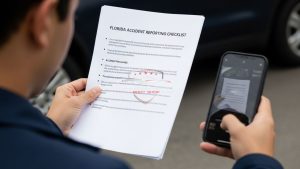
Your Florida Accident Reporting Checklist
Print this and keep it in your glove box:
At the Scene:
☐ Check for injuries—if yes, call 911 immediately
☐ Assess if vehicles can be safely driven—if no, call police
☐ Even if not required, consider calling police anyway
☐ Exchange information with all drivers
☐ Take extensive photos
☐ Get witness contact information
☐ Document everything in writing
After the Scene:
☐ Notify your insurance within 24 hours
☐ Seek medical attention within 14 days (Florida PIP rule)
☐ File DMV report within 10 days if damage exceeds $500
☐ Get professional damage assessment
☐ Keep all documentation organized
We’re Here to Help Navigate the Mess
At Procar Auto Bodyshop, we’re not just fixing cars—we’re helping you navigate the complex world of accident reporting, insurance claims, and legal requirements.
Our Free Services:
- Damage assessment and repair estimates
- Insurance claim documentation support
- DMV reporting assistance
- Police report review and explanation
- Coverage analysis and claim strategy
Why Choose Procar:
- 15+ years experience with Florida accident claims
- Direct relationships with all major insurance companies
- Licensed claim advisors on staff
- We handle the paperwork while you handle recovery
Contact Procar Auto Bodyshop:
- 📞 Call: 561-372-4547
- 📍 Visit: 1705 N Dixie Hwy, Pompano Beach, FL 33060
- 💻 Online: www.procarautobodyshop.com
Don’t let confusion about reporting laws cost you thousands in denied claims or legal penalties. We’ll walk you through every step.
FAQs:
1. Is a police report always required after a car accident in Florida?
No, not always. According to Florida Statute § 316.065, you are legally required to immediately notify law enforcement (call the police) only if the crash results in:
- Injury to any person (even minor complaints like neck pain or headache)
- Death of any person
- Damage to any vehicle so severe that it cannot be driven safely from the scene (usually requires Vehicle Damage Inspection)
If none of these three conditions exist (no injuries, all vehicles drivable), a police report is not legally mandatory — but getting one is still strongly recommended in most situations.
2. Should I still call the police for a minor parking lot fender bender with no injuries and drivable cars?
Yes — in almost every case you should. Even though the law does not require it, experienced insurance claim handlers strongly advise getting a police report because:
- The other driver’s story can change later when speaking to insurance
- Hidden damage often turns out to be $2,000–$5,000+ once properly inspected
- It protects you from later fraudulent injury claims
- Insurance companies process and settle claims much faster (often 20–40% higher settlements) when a police report exists
Only skip it if you personally know and fully trust the other party, damage is truly tiny (well under $500), and you accept all future risks.
3. What happens if I don’t call the police when the law says I should?
Failing to report a crash that meets the § 316.065 criteria (injury, death, or undrivable vehicle) is a second-degree misdemeanor in Florida. Possible penalties include:
- Up to 60 days in jail
- Up to $500 fine
- Points on your driving record
- Possible suspension of driving privileges
Additionally, not having a police report when one was legally required can seriously weaken your insurance claim and expose you to greater liability disputes.
4. Do I still have to file something with the DMV even if the police don’t come?
Yes — separately. Under Florida Statute § 316.066, you must file a written crash report with the Florida Department of Highway Safety and Motor Vehicles (FLHSMV) within 10 days if:
- There was injury or death, OR
- Property damage to any one person’s property totals $500 or more
In 2024–2025, almost any visible body damage (bumper, fender, door, etc.) usually exceeds $500 once properly estimated.
- If police came → They usually file it electronically for you (confirm with the officer).
- If police did not come → You must file it yourself online at www.flhsmv.gov or using Form HSMV 90010. Failure to file can result in driver’s license suspension and vehicle registration suspension.
5. What should I do right now if I had an accident but didn’t get a police report and now regret it?
You can still take strong protective steps:
- File the DMV report immediately (if damage likely > $500) — within the 10-day window
- Take detailed photos of all damage from multiple angles
- Write down everything you remember (time, location, what was said, weather, road conditions)
- Get witness statements if any exist
- Notify your insurance company as soon as possible and explain honestly why no police report was obtained
- Get a professional written damage estimate from a reputable body shop (many offer this for free) — this helps prove the extent of damage
- Keep every document, photo, text message, and estimate organized
While it’s harder without a police report, comprehensive documentation and professional support can still lead to a successful claim in most cases.

No comment