
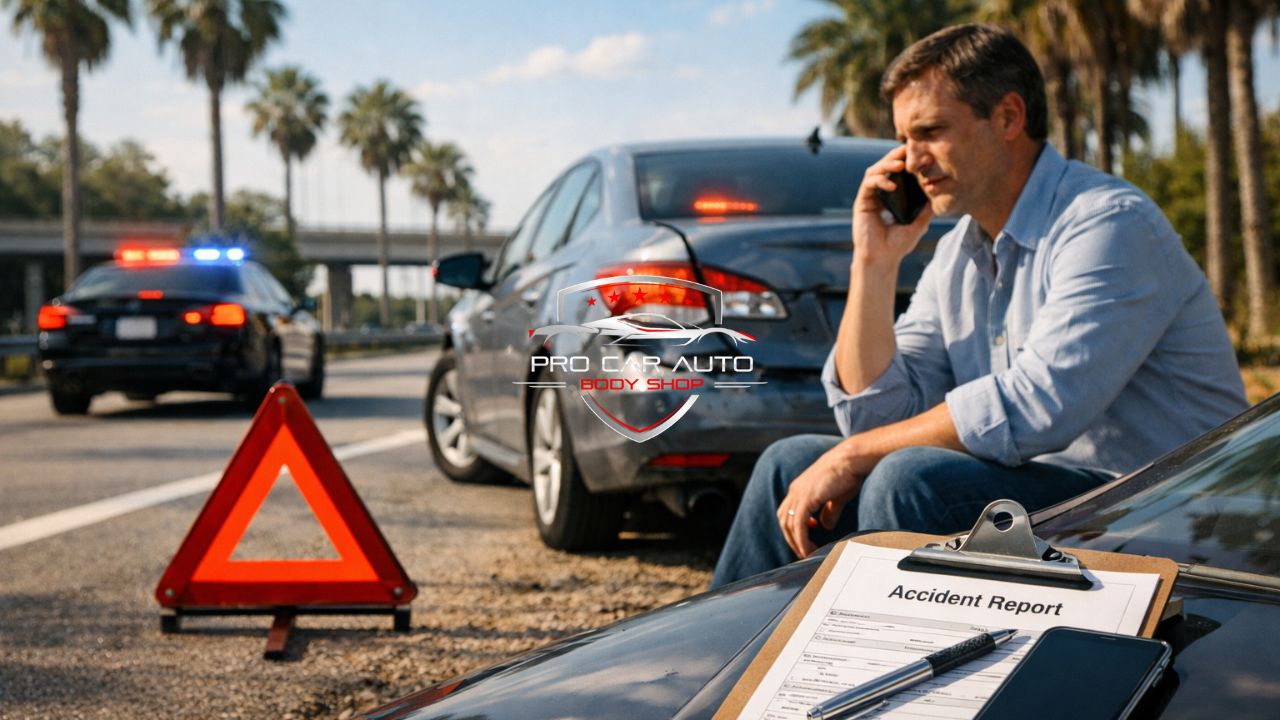
What to Do After a Car Accident in Florida: The 60-Minute Survival Guide
Listen, I’ve been in the auto body and insurance claims business in Florida for over 15 years, and I can’t tell you how many people walk into our shop completely lost after an accident. They’re stressed, confused, and making mistakes that cost them thousands—all because nobody teaches you this stuff in school.
Let me break it down for you like I’m talking to my own family. This is your 60-minute survival guide for what happens after the metal stops crunching.
Minutes 1-5: Safety First, Always
Stop. Breathe. Don’t panic.
Before you even think about your car, check yourself and your passengers. Adrenaline masks pain—move slowly and assess for injuries.
- Anyone hurt? Call 911 immediately.
- Can’t move? Stay put and wait for EMS.
- Minor fender bender? Still check everyone carefully.
If your vehicle is drivable and blocking traffic, turn on hazards and move to the shoulder. If you can’t move the car, get everyone to safety away from traffic.
Pro Tip from the Shop: Florida law requires you to move your vehicle if it’s safe and the accident is minor. Staying in traffic lanes can result in citations—and more dangerous secondary accidents.
Minutes 6-15: Call the Authorities (Yes, Even for “Small” Accidents)
Here’s where people make their first big mistake. They think, “Oh, it’s just a little bump. We’ll handle it ourselves.”
Stop right there.
I’ve seen it a thousand times: two drivers agree to “work it out,” shake hands, and drive away. Then three days later, the “friendly” driver files a claim saying YOU hit THEM, claiming injuries that never happened.
A police report is your insurance policy’s best friend.
When You MUST Call Police in Florida:
- Any injury whatsoever
- Any vehicle appears disabled or heavily damaged
- Hit and run situation
- You suspect the other driver is impaired or has no insurance
- You feel unsafe or threatened
Even in minor accidents, an official report establishes facts while memories are fresh, documents the scene professionally, and protects you from false claims later.
Pro Tip: In Florida, if the crash involves more than $500 in property damage, you’re legally required to report it to the DMV within 10 days. The police report makes this process much easier.
[CTA: Not sure if your damage exceeds $500? Stop by our shop for a free damage assessment—we’ll give you an honest evaluation in 15 minutes. No appointment needed.]
Minutes 16-25: Document EVERYTHING
Your phone is your best tool. The evidence you collect now can make or break your claim.
Take Photos and Videos of:
The Vehicles:
- All four corners of every vehicle involved
- Close-ups of every dent, scratch, and broken part
- License plates and VIN numbers
- Any fluid leaks or mechanical damage
The Scene:
- Wide shots showing vehicle positions
- Skid marks, traffic signs, and road conditions
- Property damage (guardrails, poles, fences)
- Weather and lighting conditions
Pro Tip from the Shop: Take more photos than you think you need. I’ve never had a customer complain about too much documentation, but I’ve seen dozens cry because they didn’t take enough. Storage is cheap; a disputed claim is expensive.
Do a 2-minute video walkthrough where you narrate what happened while showing the scene. This captures details you might forget later.
Minutes 26-35: Exchange Information (But Guard Yours Carefully)
Information to COLLECT:
- Full name, phone number, and address
- Driver’s license number and state
- License plate number
- Insurance company name and policy number
- Vehicle make, model, year, and color
- Witness names and contact information
Information to PROVIDE:
Give them only your name, phone number, and insurance company/policy number.
Never Give:
- Your social security number
- Your home address (license is enough)
- Details about your coverage limits
And here’s the big one: DO NOT discuss fault, apologize, or say “I’m sorry.”
Even if you think it’s your fault—zip it. “I’m sorry” can be used as an admission of guilt. Stick to facts only.
Instead, say: “Are you okay? Let’s exchange information and let the insurance companies sort this out.”
Minutes 36-45: Critical Florida-Specific Rules
This is where Florida gets weird. Our insurance laws are different from most states, and not understanding them costs people serious money.
The 14-Day Rule (This is HUGE):
Florida is a “no-fault” state, meaning your own insurance pays for your injuries regardless of who caused the accident (through Personal Injury Protection, or PIP).
But here’s the catch: You MUST seek medical attention within 14 days of the accident, or your PIP coverage won’t pay for your medical bills.
Yes, 14 days. Not 15. Not “when it starts hurting.” FOURTEEN DAYS.
Even if you feel fine, GET CHECKED OUT. Whiplash and soft tissue injuries can take days to show symptoms. I’ve seen people lose $10,000 in medical coverage because they waited too long.
Pro Tip from the Shop: Go to an ER, urgent care, or your primary doctor within 14 days and tell them you were in an accident. Even if they find nothing wrong, you’ve protected your PIP coverage.
Florida Insurance Minimums:
Every Florida driver must carry:
- $10,000 in Personal Injury Protection (PIP)
- $10,000 in Property Damage Liability (PDL)
Notice what’s NOT required? Bodily injury liability. The other driver might not have coverage for YOUR injuries if they’re at fault. This is why uninsured/underinsured motorist coverage is crucial.
[CTA: Need help navigating Florida’s insurance maze? Our team includes licensed claim advisors who can review your situation for free and tell you exactly what steps to take next.]
Minutes 46-55: Notify Your Insurance Company
Call your insurance company within 24 hours. Most policies require “prompt” notification.
What to Say:
- Report the facts: date, time, location, basic description
- Provide the other driver’s insurance information
- Mention you took photos and have documentation
- Ask about your coverage and rental car options
- Get a claim number and adjuster’s contact info
What NOT to Say:
- Don’t speculate about fault
- Don’t minimize injuries
- Don’t accept settlements on the spot
- Don’t agree to use their preferred body shop without checking it out
Pro Tip from the Shop: You have the RIGHT to choose your own body shop in Florida. Insurance companies might “recommend” shops in their network, but you’re not required to use them. We’re an independent shop, and we work for YOU, not the insurance company.
[CTA: Ready to start your repair? We work directly with all major insurance companies and handle the claim paperwork for you. Get your free estimate today.]
Minutes 56-60: Plan Your Next Steps
Immediate To-Do List (Next 24-48 Hours):
- Get medical attention (14-day rule!)
- Call your insurance if you haven’t already
- Organize your documentation in one folder
- Research body shops (see below)
- Arrange transportation if needed
Choosing a Body Shop:
Not all body shops are created equal. Here’s what to look for:
Red Flags:
- Pressure tactics
- Disorganized facilities
- No written estimates
- Won’t answer your questions
Green Flags:
- Certified technicians (I-CAR, ASE)
- Clean, modern facility
- Written warranties on repairs
- Clear communication throughout
- Good reviews from real customers
Pro Tip: A good body shop becomes your advocate in the insurance claim process. We speak the adjuster’s language and fight to get your car restored to pre-accident condition.
The Biggest Mistakes I See Every Week
Mistake #1: Waiting Too Long for Medical Care
That 14-day rule isn’t a suggestion. Don’t lose thousands in PIP coverage.
Mistake #2: Not Taking Enough Photos
You can’t go back three days later and recreate the scene. Document NOW.
Mistake #3: Apologizing at the Scene
Be kind, be helpful, but don’t admit fault. Anything you say can affect your claim.
Mistake #4: Choosing a Body Shop Based Only on Convenience
Your car is your second-largest investment. Do your research.
Mistake #5: Delaying Insurance Notification
“Prompt” notification is in your policy. Waiting can give grounds for denial.
Your Post-Accident Checklist
Immediately After:
- ☐ Check for injuries—call 911 if needed
- ☐ Move to safety if possible
- ☐ Call police for injury or major damage
- ☐ Take photos/videos of everything
- ☐ Exchange information (don’t admit fault!)
- ☐ Get witness contacts
Within 24 Hours:
- ☐ Seek medical attention
- ☐ Notify your insurance
- ☐ Organize documentation
- ☐ Start researching body shops
Within 14 Days:
- ☐ MUST have medical evaluation for PIP coverage
- ☐ File DMV report if damage exceeds $500
- ☐ Begin repair process
Final Thoughts from the Shop Floor
Accidents are stressful, expensive, and never convenient. But you’re tougher than you think, and now you’re more prepared than most people.
Remember:
- You have rights. You can choose your shop and question assessments.
- Documentation is power. Keep everything.
- Ask questions. There are no stupid questions about your safety and money.
- You’re not alone. Lean on professionals who know the system.
[We’re Here to Help]
At Procar Auto Bodyshop, we’ve been helping Florida drivers navigate post-collision chaos for over 15 years. We’re not just here to fix your car—we’re your advocate through the entire process.
Our Promise:
- Free damage assessments and estimates
- Direct insurance claim assistance
- Transparent communication every step
- Quality repairs with lifetime warranty
Get Your Free Consultation:
- 📞 Call: 561-372-4547
- 📍 Visit: 1705 N Dixie Hwy, Pompano Beach, FL 33060
- 💻 Online: www.procarautobodyshop.com
Don’t navigate this alone. We’ve got your back.

No comment